
English| EUR
Suggested for you
More currencies
Choose a language
Mount Triglav stands at 2,864 meters as the symbolic heart of Slovenia and the Julian Alps. Three primary routes lead to its summit, each offering distinct technical demands and alpine scenery. This guide maps the ascent paths, difficulty levels, and seasonal windows for safe access.
Quick answer
Three established triglav climbing routes reach the summit: the southern approach from Rudno Polje via Dolič (Grade I–II, 6–8 hours), the northern Tominšek Route from Krma Valley (Grade III, scrambling required, 7–9 hours), and the western path from Bohinj via the Seven Lakes Valley (Grade II, 8–10 hours). All routes require sure-footedness, scrambling ability, and acclimatization to alpine terrain. Weather shifts rapidly above 2,000 meters; early-season snow and afternoon thunderstorms narrow the safe climbing window.
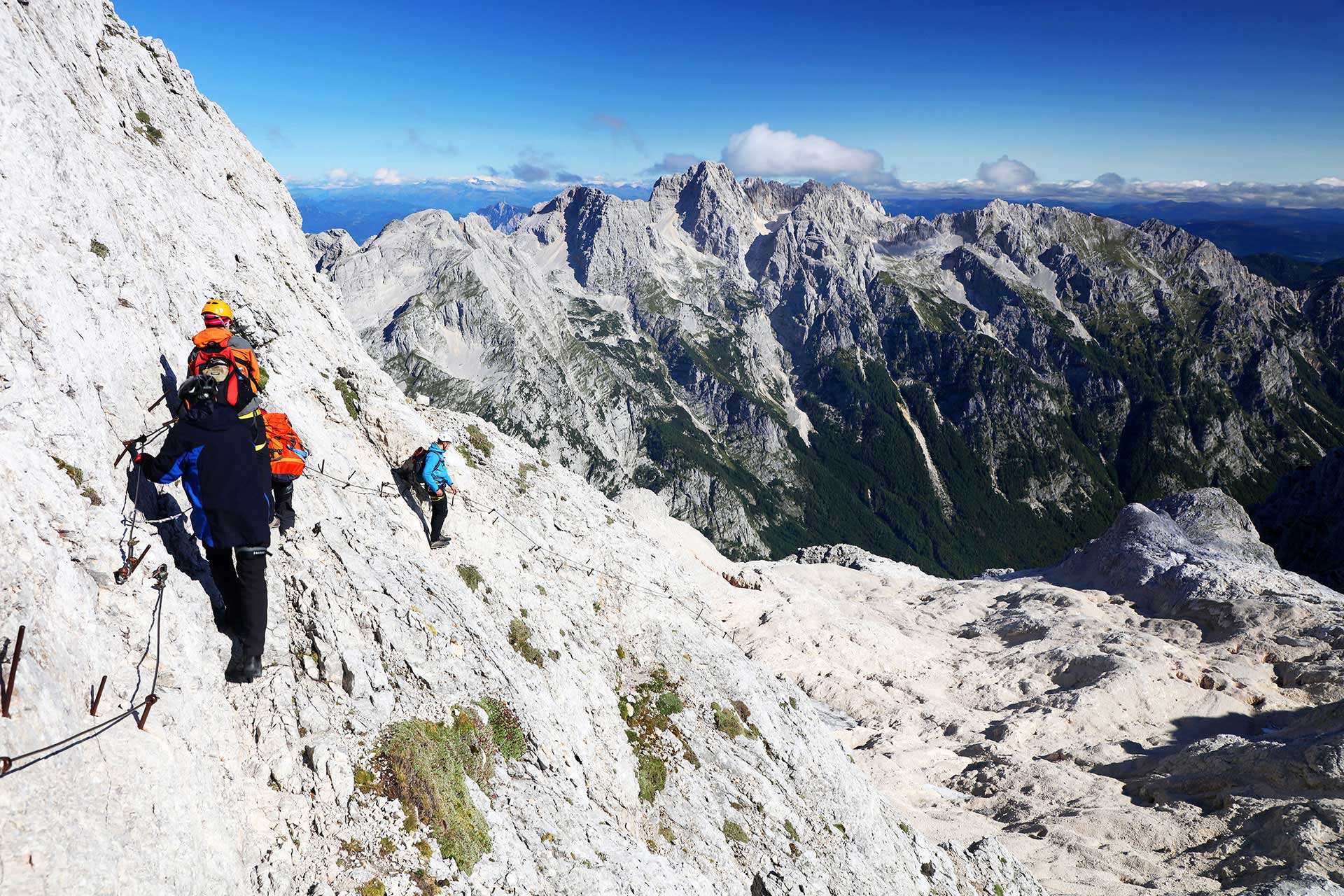
No technical climbing route in the Julian Alps carries more national weight than the ascent of Triglav. Slovenian tradition holds that every citizen should summit at least once, and the mountain's three faces have seen generations of climbers test themselves against limestone ridges, scree fields, and exposed traverses. The southern route from Rudno Polje remains the most traveled path to the summit. Climbers start at the Planika mountain hut, cross the Triglav Glacier remnant, and ascend the via ferrata–equipped southeast ridge. Steel cables and iron pegs assist on the steepest sections, but the route demands steady footing and comfort with exposure. The Aljažev Stolp tower, a sheet-metal landmark erected in 1895, marks the summit. From Krma Valley, the Tominšek Route tackles the north face with sustained scrambling and loose rock—conditions that favor experienced alpinists willing to navigate unmarked sections and manage risk in changing weather. Seasonal access varies sharply. Snow persists on all triglav climbing routes until late June, and crampons remain necessary through early July on higher traverses. August and September offer the most stable weather, though afternoon thunderstorms build with little warning. Hut networks along each path provide overnight staging: Kredarica, Planika, and Vodnikov Dom anchor the southern approach, while Triglav Lodge at Kredarica serves climbers from all directions. Reservations fill months ahead during peak summer weeks. The Seven Lakes Valley approach combines alpine tarn scenery with steady elevation gain, threading past Dvojno Jezero and the lakes of Triglav's western cirque. This route adds distance but reduces technical difficulty, making it the preferred choice for fit hikers without scrambling experience. Fixed cables appear only on the final 200-meter push to the summit pyramid. Descent follows the same path or loops via Dolič saddle, a longer option that rewards with views into the Soča watershed and Italy beyond.
“Slovenian tradition holds that every citizen should summit at least once, and the mountain's three faces have seen generations of climbers test themselves against limestone ridges, scree fields, and exposed traverses.”
Climbing Triglav requires careful preparation and navigation through protected alpine terrain. The full ascent typically spans two days with an overnight stay in a mountain hut.
Consult the Triglav National Park site or local mountain centers for current trail status and avalanche risk. Many climbers underestimate how quickly conditions change above 2,000 meters.
The three main routes—Krma Valley, Pokljuka, and Vrata Valley—vary in technical difficulty and require advance hut reservations during peak season. Beds fill weeks ahead in July and August.
Carry a detailed topographic map, headlamp, and via ferrata set for the protected sections near the summit. GPS alone is unreliable in steep terrain where signal drops.
Begin your approach by mid-morning to arrive at your chosen hut (Kredarica, Triglavski Dom, or Planika) with daylight for settling in. Late arrivals risk navigating unmarked trails in darkness.
Depart the hut between 4:00 and 6:00 to complete the final ascent and return before afternoon storms build. The via ferrata cables above 2,700 meters become hazardous when wet.
Most accidents occur on the descent when fatigue sets in and footing becomes less deliberate. Use the steel cables even if the rock feels dry, and maintain three points of contact at all times.
Hikers planning an ascent of Mount Triglav must decide between the Krma Valley route, known for its steady incline, and the Vrata Valley route, which offers a more demanding vertical experience. Choosing the appropriate path depends on individual endurance and experience with exposed terrain.
| Krma Valley Route Standard Hiking Path Recommended | Vrata Valley Route Via Ferrata Path | |
|---|---|---|
| Route Name | Krma Valley Approach | Prag Route (Vrata) |
| Starting Point | Krma Valley | Vrata Valley |
| Technical Difficulty | Moderate (Non-technical) | High (Via Ferrata) |
| Approximate Duration | 7-9 hours | 6-8 hours |
| Main Highlight | Long gradual ascent | Steep technical climbing |
Verdict: The Krma Valley route is suited for hikers seeking a long, steady walk, while the Vrata Valley route is designed for those comfortable with steep, exposed climbing requiring safety gear.
The optimal window for climbing Triglav is from late June to mid-September, when high-altitude snow has largely melted and mountain huts are fully operational. Attempting routes outside this period often involves navigating lingering snowfields or encountering early autumn storms that increase technical risks.
Warm days, cool nights (5°C to 18°C)
Stable conditions with the highest volume of climbers on the routes.
Cooler, shorter days (2°C to 14°C)
Fewer crowds, but weather patterns become less predictable with increased storm potential.
Freezing conditions, snow cover (-10°C to 5°C)
Routes require winter mountaineering skills and specialized equipment due to ice and snow.
Verdict: The most favorable period is between mid-July and early September, specifically during mid-week to avoid peak weekend congestion.
Technical routes demand proper gear and safety preparation before you attempt the exposed summit ridges.
Mount Triglav climbing routes are accessible 24/7, as Triglav National Park remains open throughout the day and night. While the terrain is technically open at all times, climbers must prioritize daylight and clear weather conditions for safe passage.
While the park is open year-round, access to climbing routes is highly dependent on seasonal weather conditions. Snow and ice may persist well into the summer, necessitating caution.
Access to Triglav National Park is free of charge for all visitors. Financial planning for your climb should focus exclusively on expenses for mountain hut accommodation and designated parking areas.
Verdict: A typical visitor pays 0 EUR for park entry, with total costs varying based on chosen mountain hut accommodation and parking duration.
Everything you need to know about triglav climbing routes
Beginners often start with the route from Krma valley, which is considered the most accessible path to the summit. Other triglav climbing routes may require significant experience with exposed limestone terrain and vertical sections.
While experienced alpinists may navigate the park independently, hiring a local guide is highly recommended for safety. Professional guides provide essential expertise on navigation, weather assessment, and proper use of climbing gear on challenging triglav climbing routes.
The entrance fee to the national park is 0 EUR. Please note that while access to the mountain remains free, you will need to budget for accommodation in mountain huts and parking fees.
The summer season from late June to September offers the most stable weather conditions for an ascent. Regardless of the calendar date, always verify current weather forecasts as the peak remains accessible 24/7 if conditions permit.
Climbing the summit involves strenuous hiking and high-altitude exposure that may be difficult for younger children. Many families prefer easier trails in the lower Triglav National Park valleys instead of technical high-altitude ascents.
To safely traverse a via ferrata, climbers must carry a certified harness, shock-absorbing lanyard, and a helmet. Carrying these items is critical when navigating the technical segments found on various triglav climbing routes.
A one-day ascent is possible for very fit individuals, though it requires an early start and excellent physical endurance. Most visitors prefer to split the climb over two days to enjoy the landscape and ensure a safer pace.
For overnight stays, you must book mountain huts directly through the Slovenian Alpine Association website. These huts are essential for resting during multi-day expeditions in the region.